Fighting fires, smashing the patriarchy and studying hard for a degree they won’t even earn. Our intrepid band of firefighters were a busy gang. But amongst all their studies and drills, they also found time for fun – and one of the many activities they enjoyed was singing.
Many of the fire brigade were members of the Girton Choral Society. They rehearsed regularly, and held Musical Evenings at Girton as well as larger concerts elsewhere. Their events featured a mix of soloists and choral numbers with Schubert, Mendelssohn and Wagner choruses all being regular features. Starting as a member of the choir, Hertha – then known as Miss Sarah Marks – eventually became the choir leader.
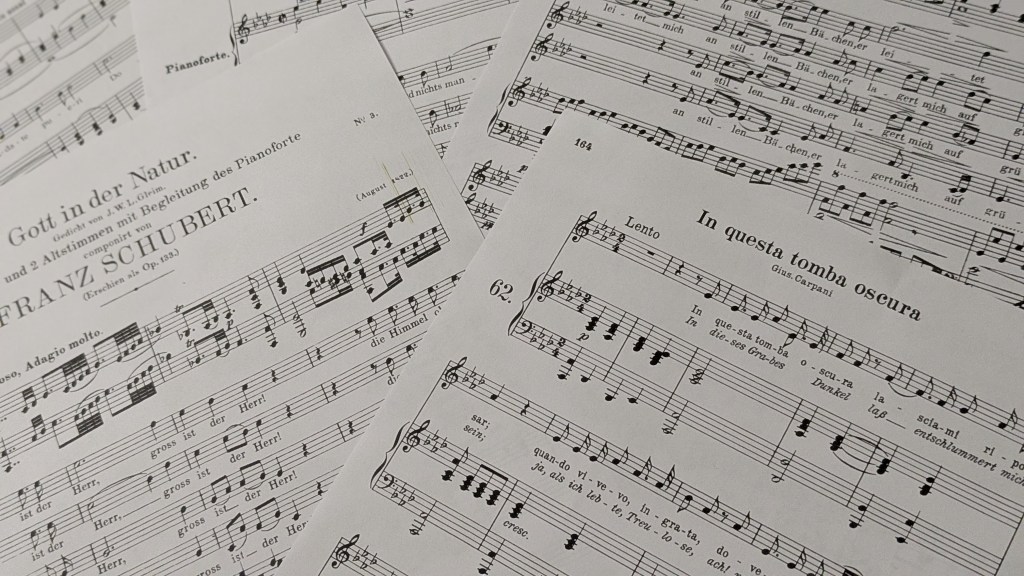
“Miss Marks left many memories behind her of participation in concerts and dramatic entertainments. She was always prominent in the Choral Society, sang at many of its concert“—more than one of her contemporaries remember her beautiful rendering of ” In questa Tomba “—and before she left Cambridge proudly became its leader.”
The Drama Society occasionally put on works involving music too. In November 1883 they put on The Elektra of Sophokles, featuring music adapted from Mendelssohn’s music from Antigone, with Charlotte as one of the Maidens of Mukenai and Ethel as the General Manager. Music wasn’t just for the societies though. Those who knew Hertha at Girton mention sitting on haystacks in the fields around the college, listening to her sing French folk songs:
“All who knew her at Girton mention her beautiful rendering of the old French songs she had learnt from Dr. Bodichon, which she used to sing unaccompanied. The same correspondent describes, as a charming and fadeless memory,” how she was once invited to “come to the stacks and hear Miss Marks sing.”
We’ll definitely be bringing the haystacks to the musical – and if you happen to be joining us at the Birmingham Hippodrome New Musicals showcase on Thursday 6th March you will hear all about one of them!
College songs were hugely popular at Girton and had been part of their culture for some time. Normally set to popular tunes from the time with lyrics written by students, many of them are still sung today. The Girton Pioneers is one such song, written by “several students at Hitchin” (where the College for Women at Benslow House was established, which later moved to Girton) in 1873, set to the tune of the British Grenadiers. It is still sung today at feasts and celebrations. Similarly, ask a Girton student and many will still remember the Hockey song!
A couple of our fabulous firefighters also got involved. Our research at Girton archive revealed that Charlotte and Ethel also wrote lyrics during their Girton years. Charlotte’s were about Girton girls leaving the college and reuniting in song:
“And when their names we sing
And make the College ring”
— Lyrics written by Charlotte, Christmas 1877
Ethel chose to pen lyrics about Charlotte – writing a couple of songs about the college recognising her achievements as the first women to have her results recognised by men at the college, and celebrating the subsequent approval of Cambridge Honour Examinations being open to all women. Both incredibly important moments both for women students and for our firefighting gang. Head to Girton College’s Feast page to have a listen to both Ethel’s song about Charlotte and the Hockey Song – and listen out for future performances where you will be able to hear some of these songs woven into the show.
Whether formally or informally, in concerts or round fires in rooms, singing definitely formed a huge part of the college life of all our firefighters. Be it writing their own songs, as part of the college Societies, French songs or folk ditties, moments that beautifully reflect Girton’s musical life and will naturally be infused throughout the musical. Stay tuned for more information about how we’ll be using one of the college songs in particular! However, to capture our firefighters’ fiery spirits and elevate them for a musical theatre audience we’ve combined some of those classical choral harmony elements with jazz inflections and a cappella vocals to create a fiery quintet ready to burst on to the stage, run some fire drills and put out some fires – as you can hear from 11 minutes 30 here, in our own version of a Girton College Fire Brigade anthem!
References:
- Hertha Ayrton, A Memoir by Evelyn Sharp
- Girton College Songs from 1910
- Personal Papers of Ethel Sargant, 1871 – 2008 – Girton Archive
- The Girton Review, 1882 – 1886
- Girton College website, 2109 Feast and 2020 Feast
 The Cambridge First All-Ladies Fire Brigade
Leave a comment